#include <span>#include <vector>#include "hpfem/core/types.hpp"#include "hpfem/mesh/adaptive_mesh.hpp"
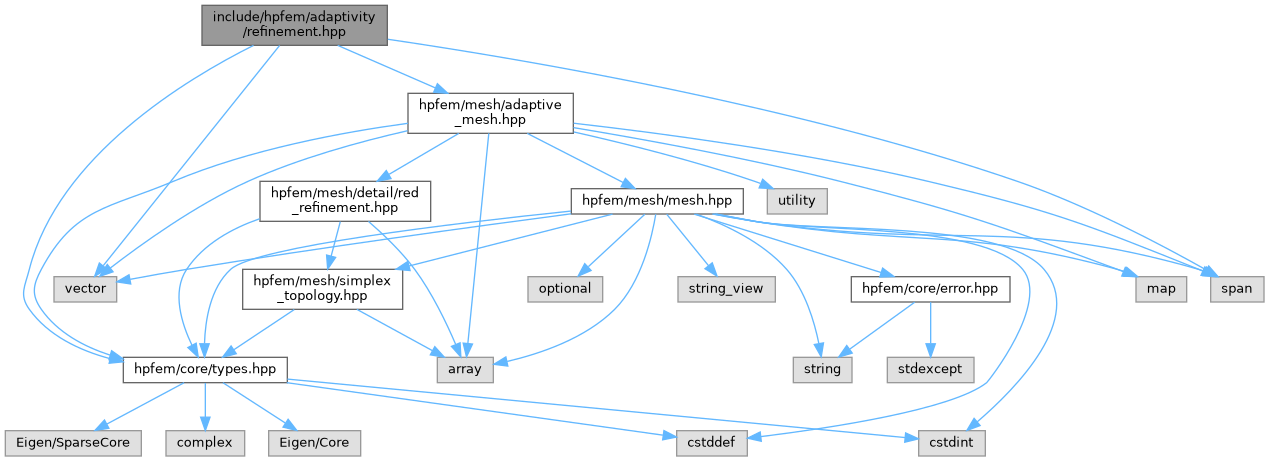
Include dependency graph for refinement.hpp:
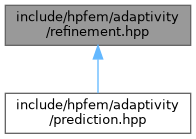
This graph shows which files directly or indirectly include this file:
Go to the source code of this file.
Classes | |
| struct | hpfem::adaptivity::HpStep |
| Result of an hp-refinement step: the mesh relation and the orders of the new cells. More... | |
Namespaces | |
| namespace | hpfem |
| namespace | hpfem::adaptivity |
Functions | |
| std::vector< int > | hpfem::adaptivity::p_refine (std::span< const int > orders, std::span< const Index > marked, int increment=1, int max_order=0) |
| template<int Dim> | |
| HpStep | hpfem::adaptivity::hp_refine (mesh::AdaptiveMesh< Dim > &mesh, std::span< const int > orders, std::span< const Index > h_marked, std::span< const Index > p_marked, int increment=1, int max_order=0, bool spread_p=true) |
| mesh::RefinementStep | hpfem::adaptivity::identity_step (Index num_cells) |
The step relating a mesh to itself (pure p-refinement), for assembly::prolongate. | |
| template<int Dim> | |
| std::vector< mesh::RefinementStep > | hpfem::adaptivity::refine_at_points (mesh::AdaptiveMesh< Dim > &mesh, std::span< const Point< Dim > > points, int levels, Real tolerance=1e-9) |
| template std::vector< mesh::RefinementStep > | hpfem::adaptivity::refine_at_points< 2 > (mesh::AdaptiveMesh< 2 > &, std::span< const Point< 2 > >, int, Real) |
| template std::vector< mesh::RefinementStep > | hpfem::adaptivity::refine_at_points< 3 > (mesh::AdaptiveMesh< 3 > &, std::span< const Point< 3 > >, int, Real) |
| template HpStep | hpfem::adaptivity::hp_refine< 2 > (mesh::AdaptiveMesh< 2 > &, std::span< const int >, std::span< const Index >, std::span< const Index >, int, int, bool) |
| template HpStep | hpfem::adaptivity::hp_refine< 3 > (mesh::AdaptiveMesh< 3 > &, std::span< const int >, std::span< const Index >, std::span< const Index >, int, int, bool) |
Detailed Description
The REFINE step of the adaptive loop: raising polynomial orders of marked cells (p-refinement) and combining it with the local h-refinement of mesh::AdaptiveMesh. Entity orders follow the minimum rule of the DoF maps, so a raised cell order enlarges the space in the cell interior at once and on an edge / face only when all its cells are raised; the spaces stay nested, hence assembly::prolongate transfers solutions exactly. See docs/theory/hp-adaptivity.md#loop.
