#include <array>#include <vector>#include <Eigen/Core>#include "hpfem/core/types.hpp"#include "hpfem/materials/material.hpp"#include "hpfem/physics/layer_stack.hpp"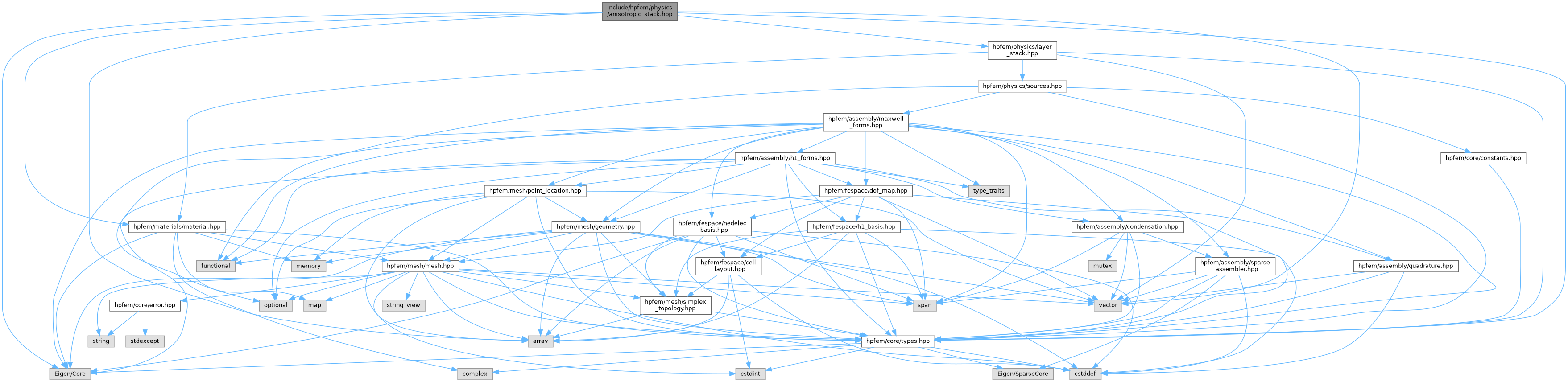
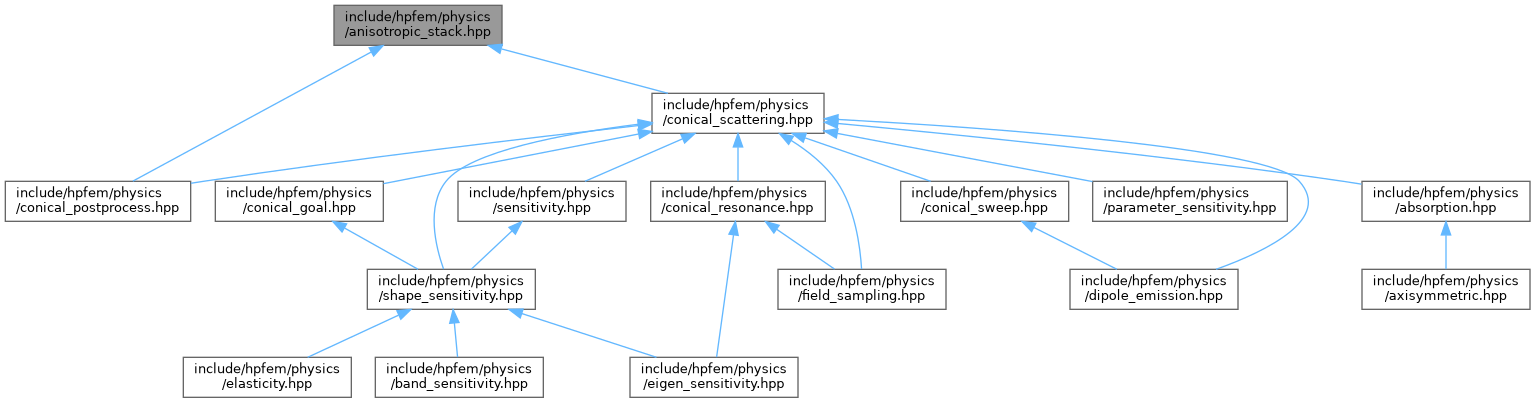
Go to the source code of this file.
Classes | |
| struct | hpfem::physics::StackResponse |
| struct | hpfem::physics::HalfSpaceModes |
| struct | hpfem::physics::AnisotropicPlaneWave |
| class | hpfem::physics::AnisotropicStack |
Namespaces | |
| namespace | hpfem |
| namespace | hpfem::physics |
Typedefs | |
| using | hpfem::physics::TangentialField = Eigen::Matrix< Complex, 4, 1 > |
| Tangential field \( (E_x, E_y, Z_0H_x, Z_0H_y) \) of a plane wave or a mode. | |
Enumerations | |
| enum class | hpfem::physics::SubstrateMode { hpfem::physics::kS , hpfem::physics::kP , hpfem::physics::kOrdinary , hpfem::physics::kExtraordinary , hpfem::physics::kBiaxial } |
Functions | |
| HalfSpaceModes | hpfem::physics::half_space_modes (const materials::Tensor3 &eps, Real a, Real b, bool upward) |
Detailed Description
Planar stacks of crystal layers (ADR-0015 §5, M19 S4): plane-wave reflection and transmission of layers and a substrate with symmetric permittivity tensors in the laboratory frame (x, y in the layer plane, z the layer normal; the wave comes from an isotropic, lossless incidence medium above the top interface and travels towards −z). Convention exp(−iωt): a lossy medium has a positive semi-definite Im ε.
Per region the in-plane wavevector fixes the Berreman system \( \psi' = ik_0K\psi \) for the tangential fields \( \psi = (E_x, E_y, \tilde H_x, \tilde H_y) \), \( \tilde H = Z_0H \), with \( E_z, H_z \) eliminated (this needs \( \varepsilon_{zz} \ne 0 \)). K is never diagonalised: two ordered complex Schur forms per region give orthonormal bases of the upward and the downward invariant subspaces and the triangular 2×2 blocks of K on them, which stay well defined for degenerate modes (isotropic layers, an optic axis along z) and at defective points (Voigt waves of absorbing biaxial media). Layers are crossed with the 2×2 exponentials of these blocks, and the reflection matrices are built by a stable S-matrix recursion from the substrate upwards that only ever multiplies decaying exponentials. Theory: docs/theory/anisotropic-stack.md.
