#include <functional>#include <optional>#include <span>#include <vector>#include <Eigen/Core>#include "hpfem/core/types.hpp"#include "hpfem/fespace/dof_map.hpp"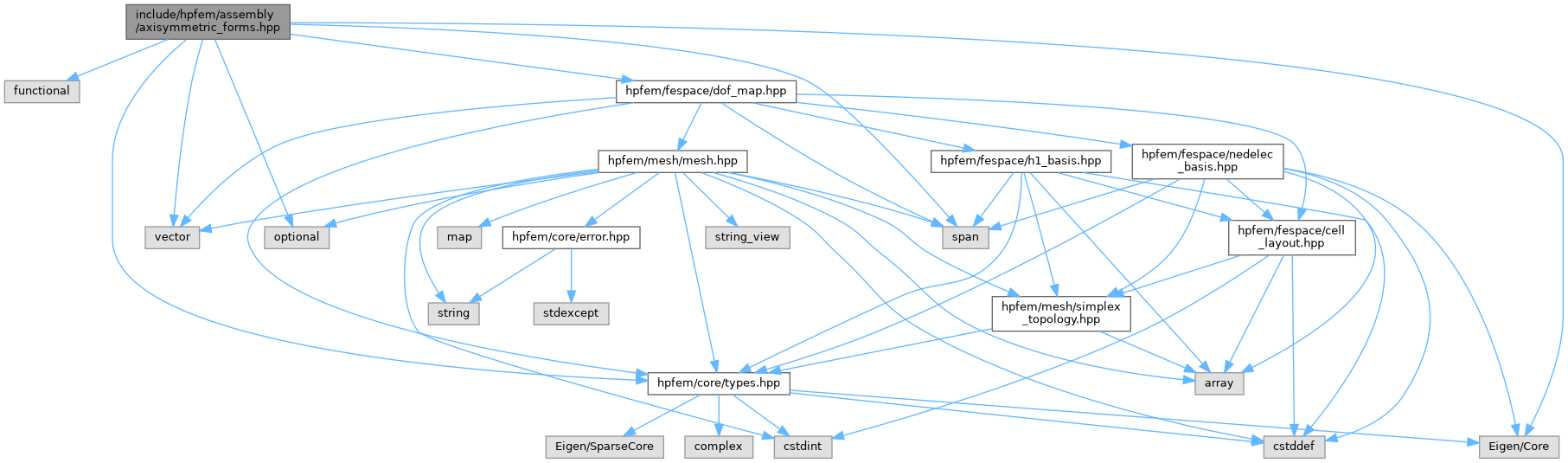
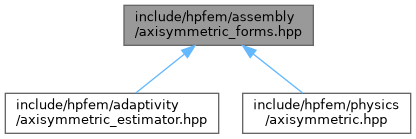
Go to the source code of this file.
Classes | |
| struct | hpfem::assembly::AxisymmetricForm |
| struct | hpfem::assembly::AxisymmetricSystem |
Namespaces | |
| namespace | hpfem |
| namespace | hpfem::assembly |
Typedefs | |
| using | hpfem::assembly::AxisymmetricTensorField = std::function< Eigen::Matrix< Complex, 3, 1 >(const Point< 2 > &)> |
| Diagonal tensor in cylindrical components (r, φ, z) as a function of the meridian point. | |
| using | hpfem::assembly::AxisymmetricFormFactory = std::function< AxisymmetricForm(Index)> |
Functions | |
| AxisymmetricSystem | hpfem::assembly::assemble_axisymmetric (const fespace::NedelecDofMap< 2 > &nedelec, const fespace::DofMap< 2 > &h1, int m, const AxisymmetricFormFactory &form_of_cell, int extra_order=2, std::span< const Index > cells={}) |
| SparseMatrix | hpfem::assembly::axisymmetric_gradient (const fespace::DofMap< 2 > &h1, const fespace::NedelecDofMap< 2 > &nedelec, int m) |
| std::vector< Index > | hpfem::assembly::axis_cells (const mesh::Mesh< 2 > &mesh, Real tolerance=1e-10) |
Cells with at least one vertex on the axis r = 0 (within tolerance times the largest r). | |
Detailed Description
Maxwell forms of a body of revolution for one azimuthal order m (2.5D): the field \( E = (E_r, E_\varphi, E_z)(r, z)\, e^{im\varphi} \) on the meridian mesh (coordinates x = r ≥ 0, y = z) with the meridian components \( (E_r, E_z) \) in the 2D Nédélec space and the scaled azimuthal component \( v = -i\, r E_\varphi \) in the H1 space of the same order. With this scaling the gradient of a mode \( \psi e^{im\varphi} \) is \( (\nabla_{rz}\psi,\ v = m\psi) \), exactly representable in the discrete spaces, and all matrices are real symmetric for lossless media (complex symmetric otherwise). The bilinear forms per m (φ-integration done, factor 2π dropped) read
\[ a(E, V) = \int \Big[ \mu_r^{-1}\frac{(mE_z - \partial_z v)(mV_z - \partial_z w)}{r} + \mu_\varphi^{-1} (\partial_z E_r - \partial_r E_z)(\partial_z V_r - \partial_r V_z)\, r + \mu_z^{-1}\frac{(\partial_r v - mE_r)(\partial_r w - mV_r)}{r} \Big] dr\,dz , \]
\[ b(E, V) = \int \big[ \varepsilon_r E_r V_r\, r + \varepsilon_\varphi v w / r + \varepsilon_z E_z V_z\, r \big] dr\,dz , \]
with diagonal material tensors in (r, φ, z) (cylindrical PML tensors fit). The 1/r terms are rational on cells touching the axis; those cells use a quadrature rule two degrees higher. The axis conditions per m (v = 0 for all m, E_z = 0 for m ≠ 0) are applied by the problem classes as Dirichlet data. See docs/theory/axisymmetric.md and ADR-0010.
