#include <vector>#include "hpfem/core/types.hpp"#include "hpfem/mesh/mesh.hpp"#include "hpfem/physics/band_structure.hpp"#include "hpfem/physics/shape_sensitivity.hpp"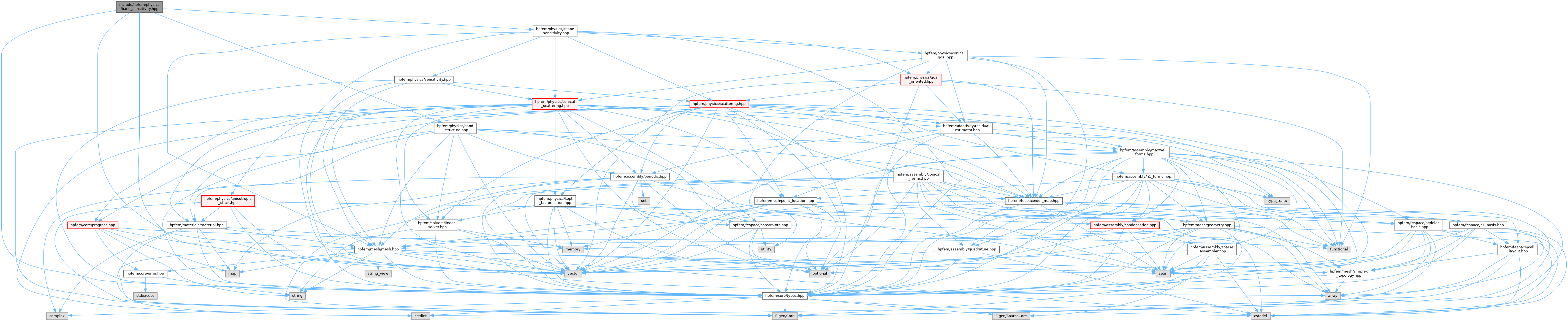
Go to the source code of this file.
Classes | |
| struct | hpfem::physics::BandDerivative |
Namespaces | |
| namespace | hpfem |
| namespace | hpfem::physics |
Detailed Description
Derivatives of photonic bands (BandStructure) with respect to material and shape parameters and the Bloch wave vector (group velocity), without a further eigensolve. Convention exp(−iωt), SI units, lossless media. At the wave vector k the reduced pencil \( A(p)\,u = \lambda\,B(p)\,u \) with \( A = P^H S P \), \( B = P^H M P \), \( \lambda = k_0^2 \) is Hermitian, so the left eigenvector of a simple eigenvalue is the right one and (Hellmann–Feynman)
\[ \frac{d\lambda}{dp} = \frac{u^H(\partial_p A - \lambda\,\partial_p B)\,u}{u^H B u}, \qquad \frac{dk_0}{dp} = \frac{1}{2k_0}\frac{d\lambda}{dp}, \qquad \frac{d\omega}{dp} = c_0\,\frac{dk_0}{dp} . \]
With the full-size mode \( w = P u \) (Bands::modes, kept with BandStructureSetup::keep_modes):
- permittivity of the cells with a tag: \( \partial B = P^H M_{\text{tag}} P \), so \( d\lambda = -\lambda\,w^H M_{\text{tag}} w \) ( \( M_{\text{tag}} \): mass matrix of the tagged cells with \( \varepsilon_r = 1 \));
- permeability: \( \partial A = -\mu_r^{-2}\,P^H S_{\text{tag}} P \);
- shape (mesh velocity V, ADR-0011): \( \partial S, \partial M \) by one central directional difference of the element matrices per moving cell; the constraints do not depend on the geometry because V must vanish on the periodic faces;
- wave vector along a direction d: only P depends on k, \( \partial A - \lambda\,\partial B = \partial P^H (S - \lambda M) P + P^H (S - \lambda M)\,\partial P \), with \( \partial P \) by a central difference of the Bloch prolongation in k (no solve; the phases are smooth, truncation \( O(10^{-10}) \) relative).
Degenerate bands. Consecutive bands whose eigenvalues differ by at most degeneracy_tolerance relative (and bands at \( k_0 = 0 \)) form a cluster with modes W. Hellmann–Feynman does not apply to a multiple eigenvalue; its derivatives are the eigenvalues of the small Hermitian pencil
\[ W^H(\partial A - \tfrac12(\Lambda\,\partial B + \partial B\,\Lambda))W\,y = \mu\,W^H B W\,y , \]
assigned in ascending order to the bands of the cluster: they are the one-sided derivatives of the branches that leave the degenerate point with increasing p (the eigenvalues of \( \lambda(p + h) \) sorted, \( h \to 0^+ \)). For a simple band this is Hellmann–Feynman. For the group velocity at a degenerate point each component is the sorted spectrum of its own cluster matrix; branch velocities along a path need the directional derivative band_wave_vector_derivative along that path. See docs/theory/maxwell.md#band-derivatives-and-group-velocity.
