#include <cstddef>#include <span>#include <utility>#include <vector>#include "hpfem/core/types.hpp"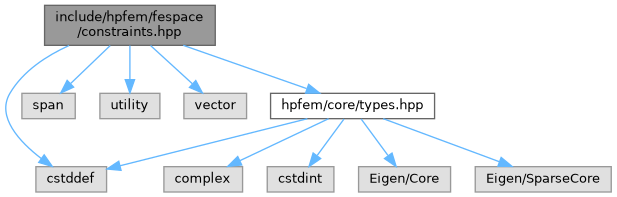
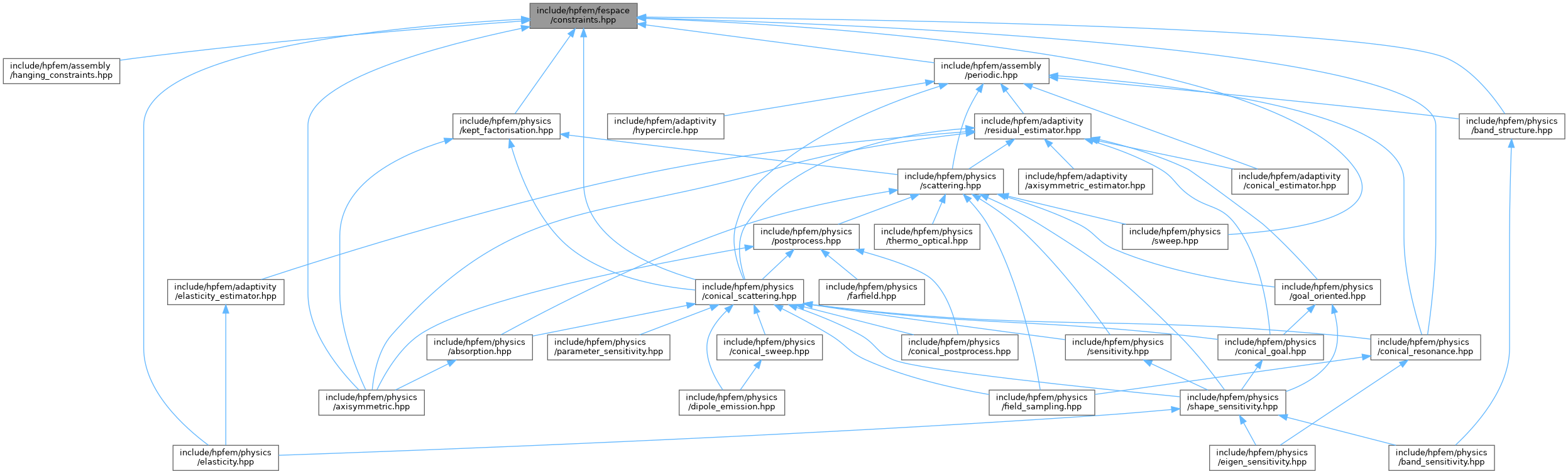
Go to the source code of this file.
Classes | |
| class | hpfem::fespace::Constraints |
| struct | hpfem::fespace::Constraints::Term |
Namespaces | |
| namespace | hpfem |
| namespace | hpfem::fespace |
Detailed Description
Linear constraints between degrees of freedom, \( x_s = \sum_i c_i\, x_{m_i} \) (slave = combination of masters with complex coefficients): Bloch-periodic boundaries now, hanging nodes of irregular refinement later (docs/theory/hp-adaptivity.md). Chains (a master that is itself a slave) are resolved by substitution; cycles are rejected. Constraints are applied to an assembled system by the prolongation \( x = P x_f \) of the free DoFs: \( A_f = P^H A P \), \( b_f = P^H b \). The conjugate transpose selects the test functions with the conjugate coefficients: for Bloch phases \( e^{ik\cdot a} \) with real k the boundary terms of the weak form cancel only against test functions of phase \( e^{-ik\cdot a} \) (for real coefficients, hanging nodes, it is the plain transpose). For a complex wave vector (|phase| ≠ 1) the conjugate is not analytic in k; a separate test space \( Q \) of the same structure (set_test, the phases \( 1/\bar\lambda \)) gives \( Q^H A P \), analytic in k and equal to \( P^H A P \) for real k. See docs/theory/maxwell.md#bloch-periodic-constraints.
