#include <array>#include <cstddef>#include <functional>#include <type_traits>#include <Eigen/Core>#include "hpfem/adaptivity/residual_estimator.hpp"#include "hpfem/assembly/elasticity_forms.hpp"#include "hpfem/core/types.hpp"#include "hpfem/fespace/dof_map.hpp"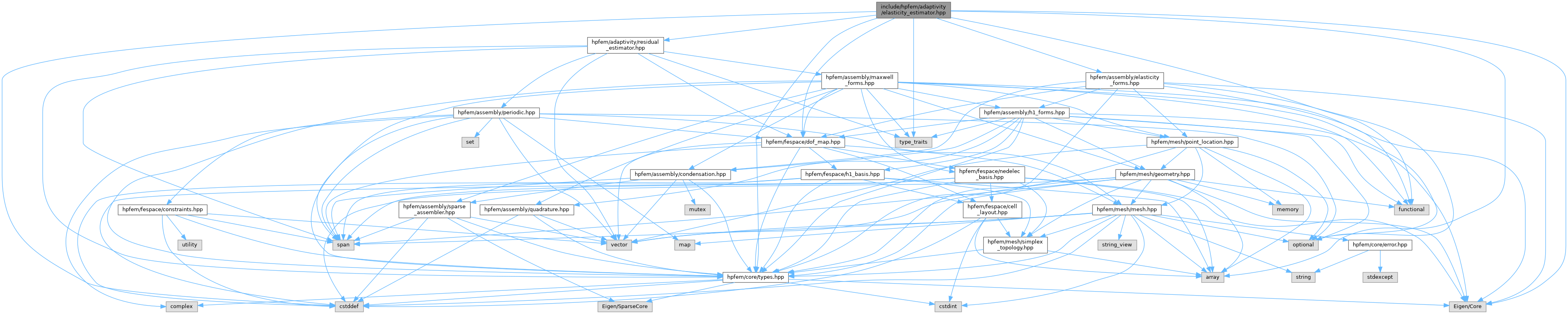
Go to the source code of this file.
Classes | |
| struct | hpfem::adaptivity::ElasticFacetCondition< Dim > |
| The natural condition on one boundary facet. More... | |
Namespaces | |
| namespace | hpfem |
| namespace | hpfem::adaptivity |
Typedefs | |
| template<int Dim> | |
| using | hpfem::adaptivity::ElasticBoundaryFactory = std::function< ElasticFacetCondition< Dim >(Index facet)> |
| The condition of a boundary facet by its id. | |
Detailed Description
Residual-based a-posteriori error estimator of small-strain linear elasticity \( -\nabla\cdot\sigma = f \), \( \sigma = C : (\varepsilon(u) - \varepsilon^*) \) on the vector H1 space (assembly/elasticity_forms.hpp, ADR-0016), in the energy norm \( |||e|||^2 = \int \varepsilon(e) : C : \varepsilon(e) \) (Verfürth 2013, ch. 4.3; hp weights after Melenk & Wohlmuth 2001). Per cell K with diameter h_K, order p_K and the modulus scale \( 2\mu_K \) (twice the shear entry of the Voigt stiffness at the centroid),
\[ \eta_K^2 = \frac{1}{2\mu_K}\frac{h_K^2}{p_K^2}\|f + \nabla\cdot\sigma_h\|^2_{L^2(K)} + \sum_{F\subset\partial K\setminus\Gamma}\frac{1}{2\mu_F}\frac{h_F}{2p_F} \|[\![\sigma_h n]\!]\|^2_{L^2(F)} + \sum_{F\subset\partial K\cap\Gamma_N}\frac{1}{2\mu_K}\frac{h_F}{p_F} \|t - \sigma_h n\|^2_{L^2(F)}, \]
with \( \mu_F \) the larger shear modulus of the two cells (robust for stiff / soft interfaces), the interior facets including hanging child facets against the cell of their parent, and on the natural boundary \( \Gamma_N \) only the traction components that are not prescribed as displacements (symmetry planes: the tangential ones). The eigenstrain enters through σ_h, so its divergence and its jumps across material interfaces are part of the residual. In the Estimate, parts.element holds the volume term, tangential_jump the interior traction jumps and normal_jump the boundary traction residual (divergence is zero). The axisymmetric variant measures the residual of the three-dimensional equilibrium of the body of revolution with the weight r of the volume element, \( R_r = f_r + \partial_r\sigma_{rr} + \partial_z\sigma_{rz} + (\sigma_{rr} -
\sigma_{\theta\theta})/r \), \( R_z = f_z + \partial_r\sigma_{rz} + \partial_z\sigma_{zz} +
\sigma_{rz}/r \); the axis carries no term. See docs/theory/elasticity.md#error-estimation-and-hp-adaptivity-m20-s5b.
