#include <memory>#include <optional>#include <vector>#include "hpfem/assembly/condensation.hpp"#include "hpfem/core/types.hpp"#include "hpfem/fespace/constraints.hpp"#include "hpfem/solvers/linear_solver.hpp"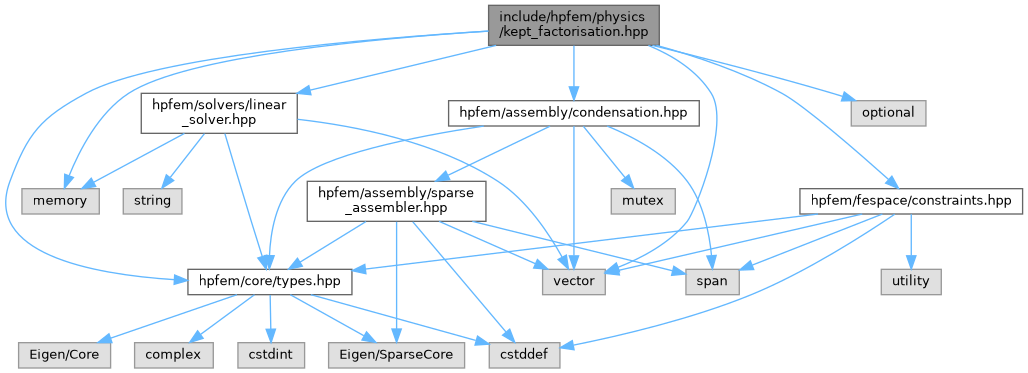
Go to the source code of this file.
Classes | |
| class | hpfem::physics::KeptFactorisation |
| struct | hpfem::physics::KeptFactorisation::Parts |
| What the solve hands over. More... | |
Namespaces | |
| namespace | hpfem |
| namespace | hpfem::physics |
Detailed Description
The factorised system of a scattering solve, kept for further solves with the same operator (ADR-0012 §4, M16 S1): tangent solves \( A s = r \) (the direct mode of the sensitivities) and adjoint solves \( A^\top z = q \), both for full-size vectors on the DoF map of the problem, without assembling or factorising again. The forward solve maps a full load to the factorised system in fixed steps — static condensation of the interior DoFs (C), selection of the unknowns (S: the conical solver drops its Dirichlet DoFs), hanging-node and Bloch constraints ( \( P^H \)), zero data on the eliminated Dirichlet DoFs — and back by the prolongation P and the interior recovery. The adjoint applies the transposes of the same steps ( \( C^\top \), \( P^\top \), \( \bar P \), the transposed interior recovery) around a transposed solve (LinearSolver::solve_transposed), so that
\[ q^\top s = z^\top r \qquad (s = \texttt{solve}(r),\ z = \texttt{solve\_adjoint}(q)) \]
holds to round-off for every pair: the adjoint is the exact transpose of the discrete solution operator, including ports, condensation and constraints. Dirichlet data is homogeneous in both (sensitivities perturb the operator and the load, not the prescribed boundary values). See docs/theory/maxwell.md#kept-factorisation.
