#include <array>#include <cstddef>#include <span>#include "hpfem/core/error.hpp"#include "hpfem/core/types.hpp"#include "hpfem/fespace/polynomials.hpp"
Include dependency graph for kernels.hpp:
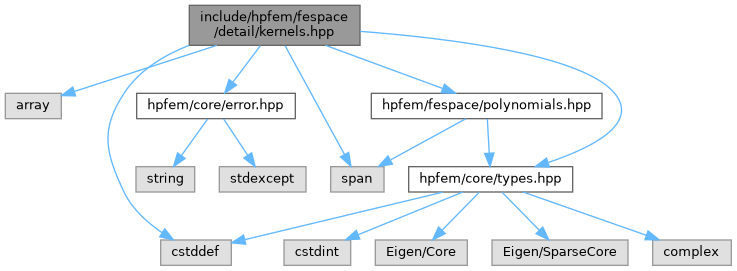
Go to the source code of this file.
Classes | |
| class | hpfem::fespace::detail::KernelArray< T > |
| struct | hpfem::fespace::detail::EdgeKernel< Dim > |
| struct | hpfem::fespace::detail::BubbleKernel< Dim > |
| The factor \( g_j(\lambda) = \lambda\,P_j(2\lambda - 1) \), j = 0..n, with gradients. More... | |
| struct | hpfem::fespace::detail::LegendreKernel< Dim > |
| Legendre factors \( P_j(2\lambda - 1) \), j = 0..n, with gradients (no λ prefactor). More... | |
Namespaces | |
| namespace | hpfem |
| namespace | hpfem::fespace |
| namespace | hpfem::fespace::detail |
Variables | |
| constexpr int | hpfem::fespace::detail::kMaxKernelOrder = 31 |
| Largest polynomial order the kernels hold (orders 0..kMaxKernelOrder). | |
Detailed Description
Shared building blocks of the hierarchical H1 and H(curl) bases: the edge kernel \( L_i^S(\lambda_b - \lambda_a, \lambda_a + \lambda_b) \) and the bubble factor \( \lambda\,P_j(2\lambda - 1) \), both with reference gradients assembled from the barycentric gradients. Internal; see docs/theory/h1-basis.md. The kernels keep their values in fixed-capacity arrays, so a basis evaluation allocates nothing (point evaluation and quadrature loops call them once per point).
