#include <complex>#include <map>#include <memory>#include <Eigen/Core>#include "hpfem/core/types.hpp"#include "hpfem/mesh/mesh.hpp"
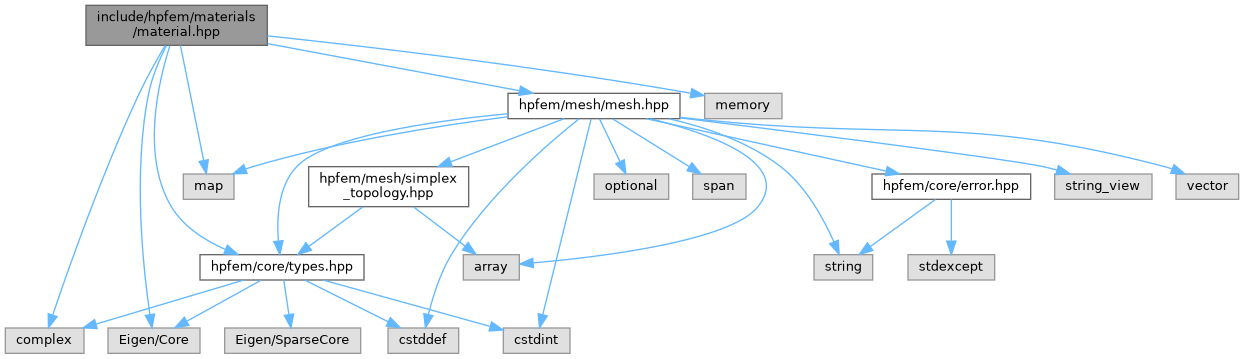
Include dependency graph for material.hpp:
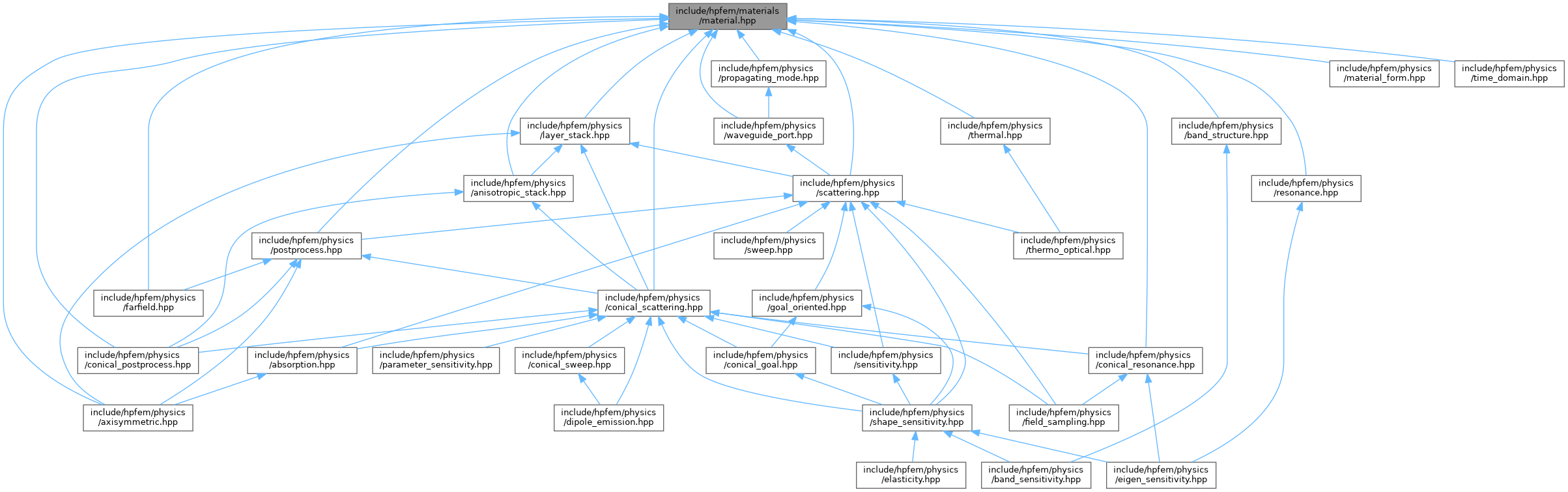
This graph shows which files directly or indirectly include this file:
Go to the source code of this file.
Classes | |
| class | hpfem::materials::Material |
| class | hpfem::materials::MaterialMap |
Namespaces | |
| namespace | hpfem |
| namespace | hpfem::materials |
Typedefs | |
| using | hpfem::materials::Tensor3 = Eigen::Matrix< Complex, 3, 3 > |
| Complex 3×3 tensor in the laboratory frame (x, y, z). | |
Functions | |
| Real | hpfem::materials::max_real_index (const Material &material) |
| void | hpfem::materials::throw_in_plane_coupling () |
| template<int Dim> | |
| Eigen::Matrix< Complex, Dim, Dim > | hpfem::materials::permittivity_tensor (const Material &material) |
| bool | hpfem::materials::is_lossless (const Material &material) |
| True if the permittivity is real (no loss and no gain), isotropic or tensor. | |
| template<int N> | |
| Real | hpfem::materials::loss_density (const Material &material, const Eigen::Matrix< Complex, N, 1 > &e) |
Detailed Description
Non-dispersive materials given by relative permittivity and permeability (complex; with the exp(−iωt) convention lossy media have Im εr > 0), isotropic or with a symmetric 3×3 permittivity tensor (ADR-0015), and their assignment to the cells of a mesh by tag. Dispersion models live in the Python layer (hpfem.materials), which evaluates them to a Material per frequency.
