#include <complex>#include <map>#include <optional>#include <set>#include <span>#include <vector>#include "hpfem/core/types.hpp"#include "hpfem/fespace/constraints.hpp"#include "hpfem/fespace/dof_map.hpp"#include "hpfem/mesh/mesh.hpp"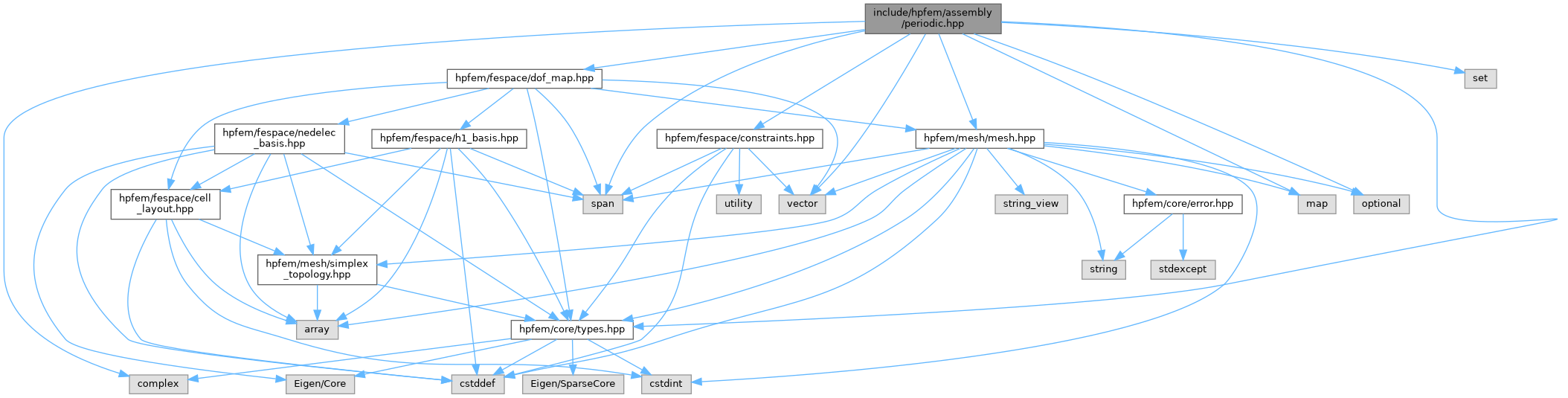
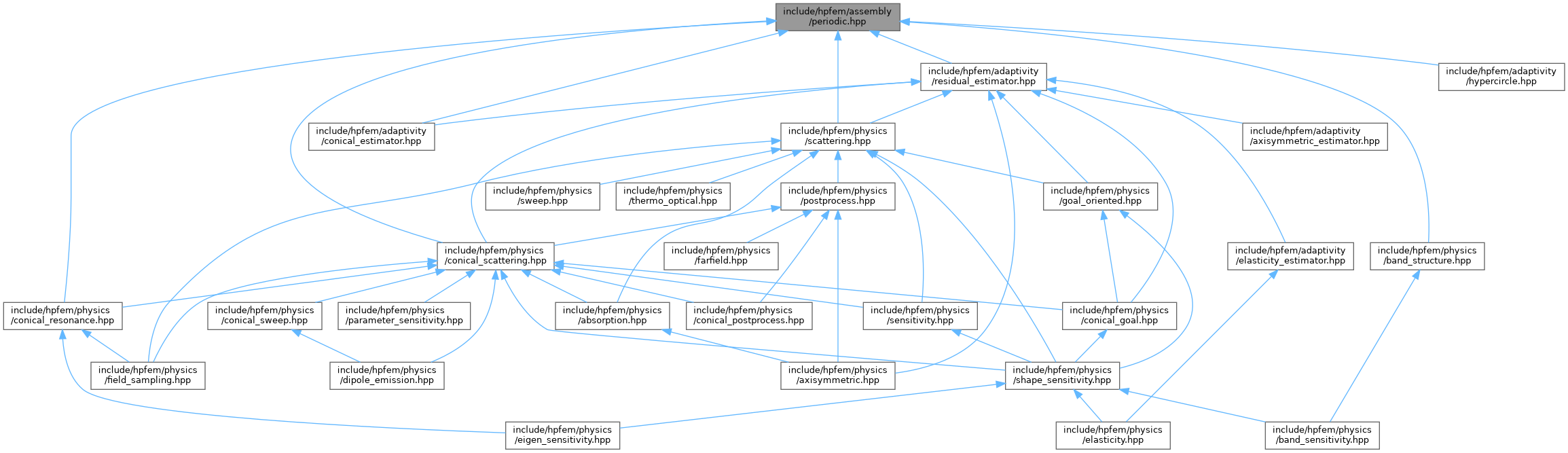
Go to the source code of this file.
Classes | |
| struct | hpfem::assembly::PeriodicPair< Dim > |
| class | hpfem::assembly::PeriodicLocator< Dim > |
| struct | hpfem::assembly::PeriodicLocator< Dim >::Partner |
Namespaces | |
| namespace | hpfem |
| namespace | hpfem::assembly |
Detailed Description
Bloch-periodic boundary conditions \( E(x + a) = e^{i k\cdot a} E(x) \) on the Nédélec and H1 spaces as DoF constraints. The facets of the two sides need not match: for every group of overlapping facets (after the shift) the coarser facet carries the trace of the coupled space, truncated to the lowest polynomial order occurring in the group (the minimum rule of the conforming hp spaces), its surplus modes are constrained to zero, and the DoFs of the finer facets are the interpolation of that trace (exact for nested facets: identical facets, facets refined on one side only, different orders on the two sides). Facets that are neither identical nor nested (unrelated meshes on the two sides) are coupled by interpolating the master trace, which is exact only up to the slave's order (a warning is logged). Identical facets with equal orders give the phase times ±1 for edges and the face permutation matrices in 3D, so the orientation bookkeeping of ADR-0003 is automatic. See docs/theory/maxwell.md#bloch-periodic-constraints.
