#include <array>#include <cstddef>#include <optional>#include <Eigen/Core>#include "hpfem/assembly/maxwell_forms.hpp"#include "hpfem/core/types.hpp"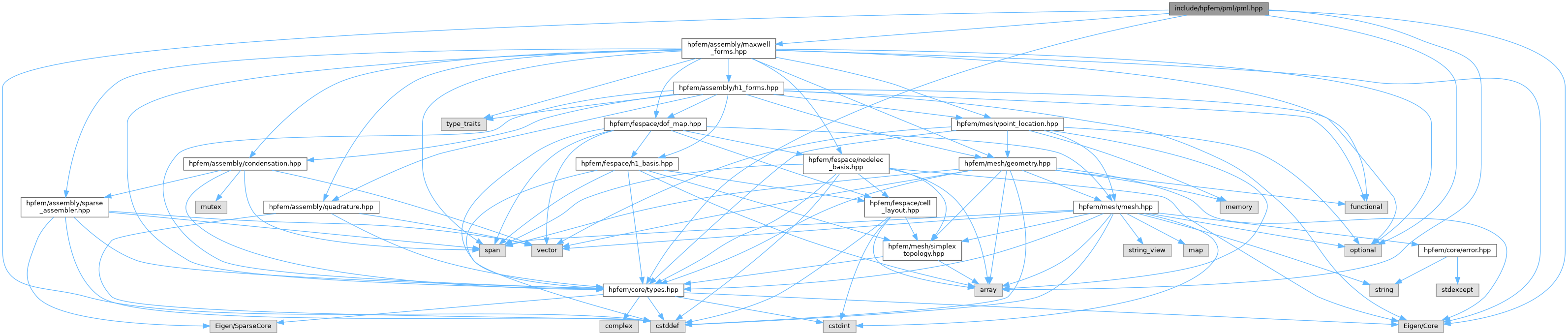
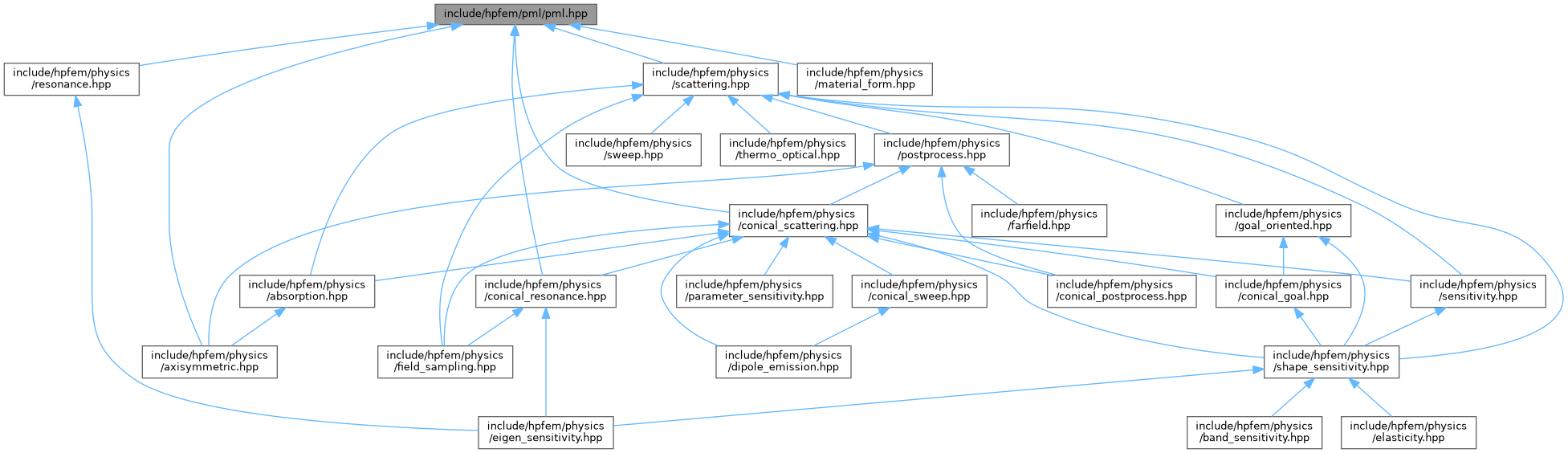
Go to the source code of this file.
Classes | |
| struct | hpfem::pml::PmlProfile |
| class | hpfem::pml::PmlBox< Dim > |
| struct | hpfem::pml::BackwardWave< Dim > |
| A wave that violates the geometric stability condition of the coordinate-stretching PML. More... | |
Namespaces | |
| namespace | hpfem |
| namespace | hpfem::pml |
Typedefs | |
| template<int Dim> | |
| using | hpfem::pml::ComplexCoordinates = Eigen::Matrix< Complex, Dim, 1 > |
| Per-axis complex stretch factors \( s_\xi \) or stretched coordinates. | |
Functions | |
| template<int Dim> | |
| std::optional< BackwardWave< Dim > > | hpfem::pml::backward_wave (const assembly::PermittivityTensor< Dim > &eps, int axis, int samples=2048) |
Detailed Description
Perfectly matched layers as complex coordinate stretching around an axis-aligned interior box: outside the box every coordinate ξ is continued as \( \tilde\xi = \xi + i\int\hat\sigma(\xi)\,d\xi \) with the dimensionless profile \( \hat\sigma = \sigma/\omega \), so that outgoing waves decay (convention exp(−iωt); the imaginary part is plus). The stretching enters the Maxwell forms as the anisotropic material tensors \( \tilde\varepsilon = \det\Lambda\,\Lambda^{-1}\varepsilon \Lambda^{-T} \), \( \tilde\mu^{-1} = \Lambda\,\mu^{-1}\Lambda^{T}/\det\Lambda \) with \( \Lambda = \mathrm{diag}(s_\xi) \), \( s_\xi = 1 + i\hat\sigma_\xi \); nothing else in the assembly changes. Theory and profile: docs/theory/pml.md.
