#include <span>#include <vector>#include "hpfem/adaptivity/refinement.hpp"#include "hpfem/adaptivity/smoothness.hpp"#include "hpfem/core/types.hpp"
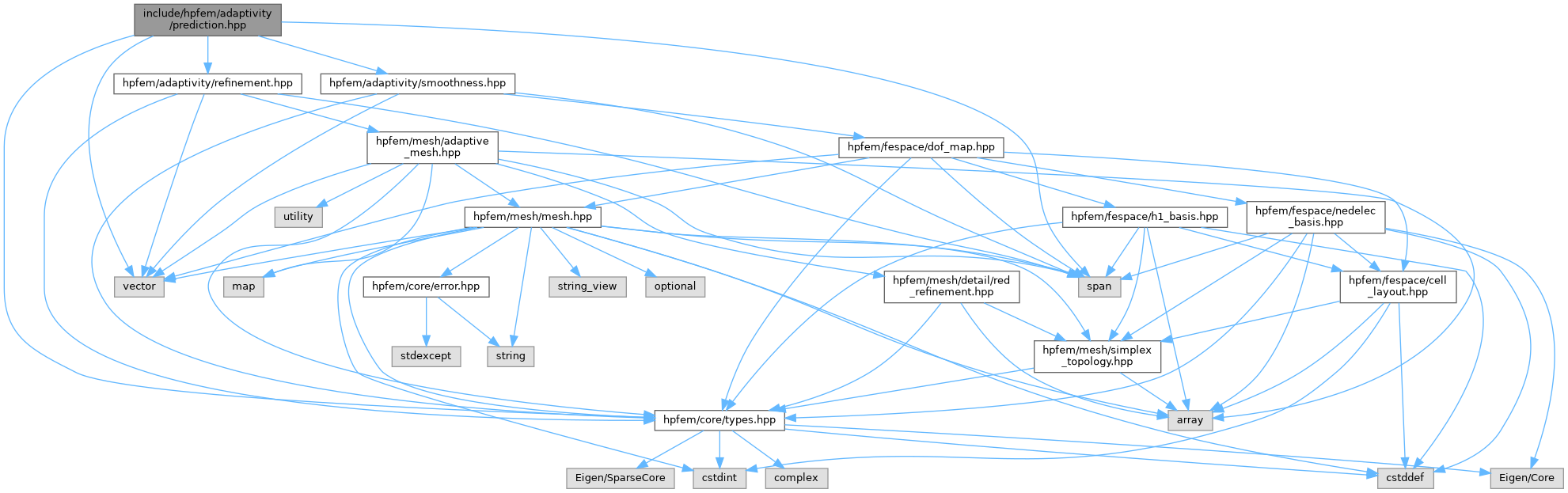
Include dependency graph for prediction.hpp:
Go to the source code of this file.
Classes | |
| struct | hpfem::adaptivity::PredictionOptions |
Namespaces | |
| namespace | hpfem |
| namespace | hpfem::adaptivity |
Functions | |
| std::vector< Real > | hpfem::adaptivity::predict_indicators (std::span< const Real > indicators, std::span< const int > orders, const HpStep &hp, const PredictionOptions &options={}) |
| HpDecision | hpfem::adaptivity::hp_decide_by_prediction (std::span< const Real > indicators, std::span< const Real > predicted, std::span< const Index > marked) |
Detailed Description
The DECIDE step of the hp loop by error prediction (Melenk & Wohlmuth 2001): after a refinement step every cell carries the indicator it would have if the solution were smooth there — \( \gamma_p\,\eta_K \) after p-refinement, \( \gamma_h\,2^{-p_K}\eta_K /
\sqrt{n_{\text{children}}} \) per child after h-refinement, \( \gamma_n\,\eta_K \) when unchanged. A marked cell whose new indicator is at most its prediction achieved the smooth rate and is p-refined next; one that fell short hides a singularity and is h-refined. Unlike the coefficient decay of the discrete solution (smoothness.hpp) this does not need the singularity to be resolved first. See docs/theory/hp-adaptivity.md#hp-decision.
