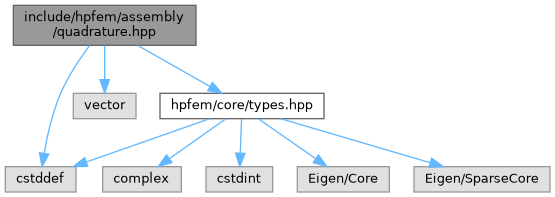
Include dependency graph for quadrature.hpp:
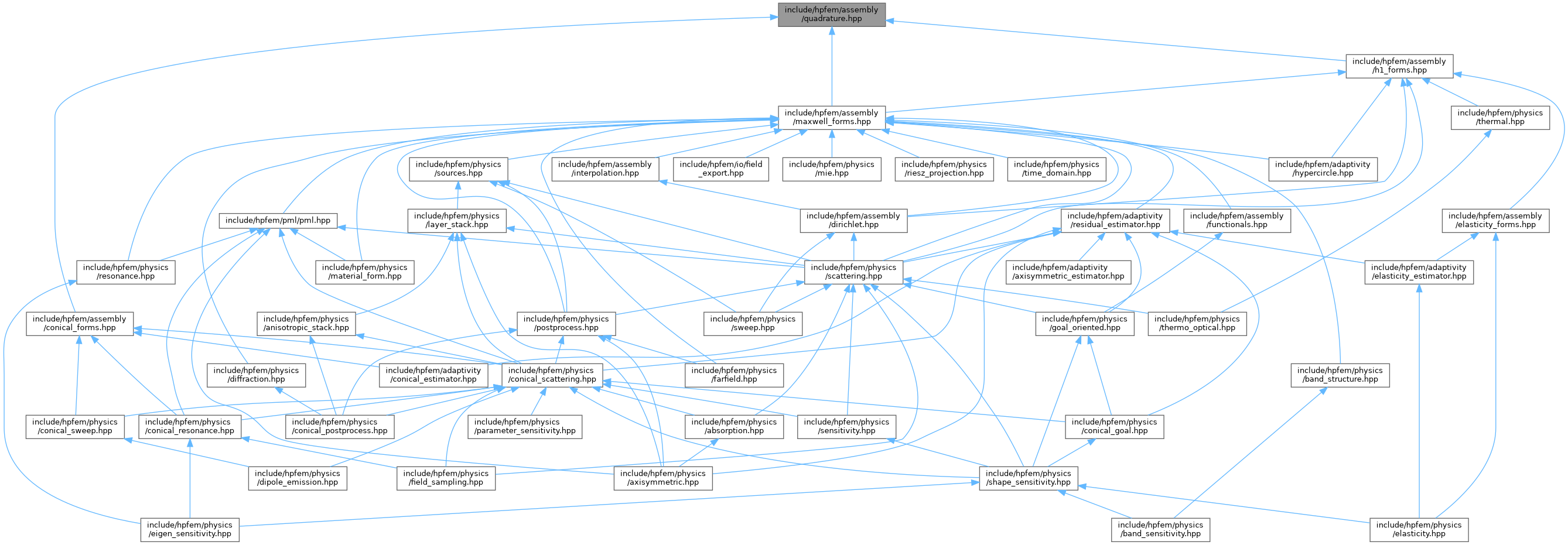
This graph shows which files directly or indirectly include this file:
Go to the source code of this file.
Classes | |
| struct | hpfem::assembly::QuadratureRule< Dim > |
Namespaces | |
| namespace | hpfem |
| namespace | hpfem::assembly |
Functions | |
| QuadratureRule< 1 > | hpfem::assembly::gauss_legendre (int n) |
| QuadratureRule< 1 > | hpfem::assembly::gauss_jacobi (int n, Real alpha, Real beta) |
| template<int Dim> | |
| QuadratureRule< Dim > | hpfem::assembly::simplex_quadrature (int order) |
| template QuadratureRule< 1 > | hpfem::assembly::simplex_quadrature< 1 > (int) |
| template QuadratureRule< 2 > | hpfem::assembly::simplex_quadrature< 2 > (int) |
| template QuadratureRule< 3 > | hpfem::assembly::simplex_quadrature< 3 > (int) |
Detailed Description
Gauss–Legendre and Gauss–Jacobi rules on [0,1] and collapsed (Duffy) Gauss–Jacobi rules on the reference triangle and tetrahedron. Formulas: docs/theory/quadrature.md. Rules of arbitrary order are generated by the Golub–Welsch algorithm, so there is no upper limit on the degree; order ≥ 2p+1 is required for mass terms (CLAUDE.md §6).
