#include <optional>#include <vector>#include "hpfem/assembly/maxwell_forms.hpp"#include "hpfem/core/types.hpp"#include "hpfem/fespace/dof_map.hpp"#include "hpfem/materials/material.hpp"#include "hpfem/mesh/mesh.hpp"#include "hpfem/pml/pml.hpp"#include "hpfem/solvers/eigen_solver.hpp"#include "hpfem/solvers/linear_solver.hpp"
Include dependency graph for resonance.hpp:

This graph shows which files directly or indirectly include this file:
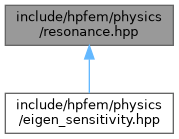
Go to the source code of this file.
Classes | |
| struct | hpfem::physics::ResonanceSetup< Dim > |
| Description of a resonance problem. More... | |
| struct | hpfem::physics::ResonantMode |
| class | hpfem::physics::Resonance< Dim > |
| Assembles and solves the resonance problem on a Nédélec space. More... | |
Namespaces | |
| namespace | hpfem |
| namespace | hpfem::physics |
Detailed Description
Resonances (quasi-normal modes) of open structures: the eigenproblem \( \nabla\times(\mu_r^{-1}\nabla\times E) = k^2\varepsilon_r E \) with PEC walls and a PML that turns the outgoing-wave condition into complex-symmetric absorbing layers, so the eigenvalues \( k^2 = \omega^2/c_0^2 \) are complex. With the exp(−iωt) convention a decaying mode has \( \mathrm{Im}\,\omega < 0 \) and the quality factor is \( Q = \mathrm{Re}\,\omega / (-2\,\mathrm{Im}\,\omega) \). The pencil (S, M) with the stretched material tensors is solved by solvers::complex_eigenpairs_near around the target frequency. See docs/theory/maxwell.md#resonances.
