#include <functional>#include <memory>#include <span>#include <vector>#include "hpfem/assembly/maxwell_forms.hpp"#include "hpfem/core/types.hpp"#include "hpfem/fespace/dof_map.hpp"#include "hpfem/solvers/linear_solver.hpp"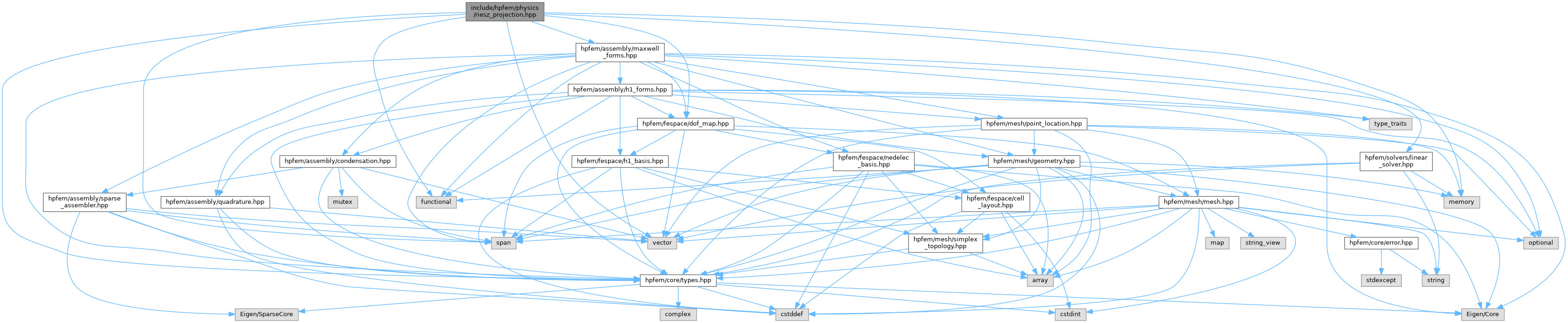
Go to the source code of this file.
Classes | |
| class | hpfem::physics::RieszPencil |
| struct | hpfem::physics::RieszSetup |
| Contour choice and integration settings. More... | |
| struct | hpfem::physics::RieszContour |
| One integration contour and what was sampled on it. More... | |
| class | hpfem::physics::RieszProjectionBase |
| class | hpfem::physics::RieszProjection< Dim > |
Riesz projection on the pencil of a Resonance problem (2D / 3D). More... | |
| class | hpfem::physics::AxisymmetricRieszProjection |
Namespaces | |
| namespace | hpfem |
| namespace | hpfem::physics |
Functions | |
| template<int Dim> | |
| std::unique_ptr< RieszPencil > | hpfem::physics::resonance_pencil (const Resonance< Dim > &problem) |
| std::unique_ptr< RieszPencil > | hpfem::physics::axisymmetric_pencil (const AxisymmetricResonance &problem) |
| template<int Dim> | |
| Vector | hpfem::physics::current_load (const fespace::NedelecDofMap< Dim > &dofs, const assembly::ComplexVectorField< Dim > ¤t, int extra_order=2) |
| template std::unique_ptr< RieszPencil > | hpfem::physics::resonance_pencil< 2 > (const Resonance< 2 > &) |
| template std::unique_ptr< RieszPencil > | hpfem::physics::resonance_pencil< 3 > (const Resonance< 3 > &) |
| template Vector | hpfem::physics::current_load< 2 > (const fespace::NedelecDofMap< 2 > &, const assembly::ComplexVectorField< 2 > &, int) |
| template Vector | hpfem::physics::current_load< 3 > (const fespace::NedelecDofMap< 3 > &, const assembly::ComplexVectorField< 3 > &, int) |
Detailed Description
Modal expansion of a source problem by Riesz projections (Zschiedrich, Binkowski, Nikolay, Burger, Lockau, Schmidt, Phys. Rev. A 98, 043806 (2018)). For the discrete pencil \( A(\omega) = S - (\omega/c_0)^2 M \) of a resonance problem (the PML frozen at its design frequency, so \( A \) is a polynomial in \( \omega \)) the solution \( x(\omega) = A(\omega)^{-1} b(\omega) \) of a source \( b \) analytic in \( \omega \) is meromorphic with simple poles at the quasi-normal modes \( \omega_n \). Cauchy's formula on a contour \( C_0 \) around the frequencies of interest with small circles \( C_n \) around the enclosed poles splits
\[ x(\omega) = \frac{1}{2\pi i}\oint_{C_0}\frac{x(\omega')}{\omega'-\omega}\,d\omega' - \sum_n \frac{1}{2\pi i}\oint_{C_n}\frac{x(\omega')}{\omega'-\omega}\,d\omega' \]
into a background and the modal contributions. For a simple pole the modal term is exactly \( R_n / (\omega - \omega_n) \) with the residue \( R_n = \frac{1}{2\pi i}\oint_{C_n} x(\omega')\,d\omega' \), valid for every \( \omega \) (inside the circle as well) and without any normalisation of the eigenvectors; poles too close to each other share a contour whose contribution keeps the \( \omega \)-dependent integral. The contours are integrated by the trapezoidal rule, which converges exponentially on circles and ellipses: the error of a contour with \( N \) points decays like \( \rho^N \), where \( \rho < 1 \) is the ratio of the contour to the distance of the nearest singularity of the integrand (another pole, or the evaluation frequency \( \omega \) itself for the background term, which therefore converges best well inside the background contour; the modal parts are subtracted from the background integrand, whose own singularities inside the contour would otherwise set the rate). Every contour point costs one factorisation of \( A(\omega') \) and one batched solve for all sources; the rule with half the points is compared for free as a convergence check. Observables enter as linear functionals \( Q(x) = q^\top x \) (point values, the emitted power \( -\tfrac12\int E\cdot J^* \) of a current source, far-field amplitudes); their modal contributions follow from the sampled values alone, so a whole spectrum costs nothing beyond the contour solves, and because \( \mathrm{Re} \) is linear the modal shares of the emitted power add up to the total exactly. Quadratic observables (fluxes, \( |E|^2 \)) are not expanded: evaluate them on expand (the exact field) or on the modal fields, aware that the cross terms are then lost. See docs/theory/maxwell.md#modal-expansion-by-riesz-projection.
