#include <cstdint>#include <optional>#include <span>#include <vector>#include "hpfem/adaptivity/residual_estimator.hpp"#include "hpfem/assembly/dirichlet.hpp"#include "hpfem/assembly/h1_forms.hpp"#include "hpfem/assembly/maxwell_forms.hpp"#include "hpfem/assembly/periodic.hpp"#include "hpfem/core/progress.hpp"#include "hpfem/core/types.hpp"#include "hpfem/fespace/dof_map.hpp"#include "hpfem/materials/material.hpp"#include "hpfem/mesh/point_location.hpp"#include "hpfem/physics/kept_factorisation.hpp"#include "hpfem/physics/layer_stack.hpp"#include "hpfem/physics/sources.hpp"#include "hpfem/physics/waveguide_port.hpp"#include "hpfem/pml/pml.hpp"#include "hpfem/solvers/linear_solver.hpp"
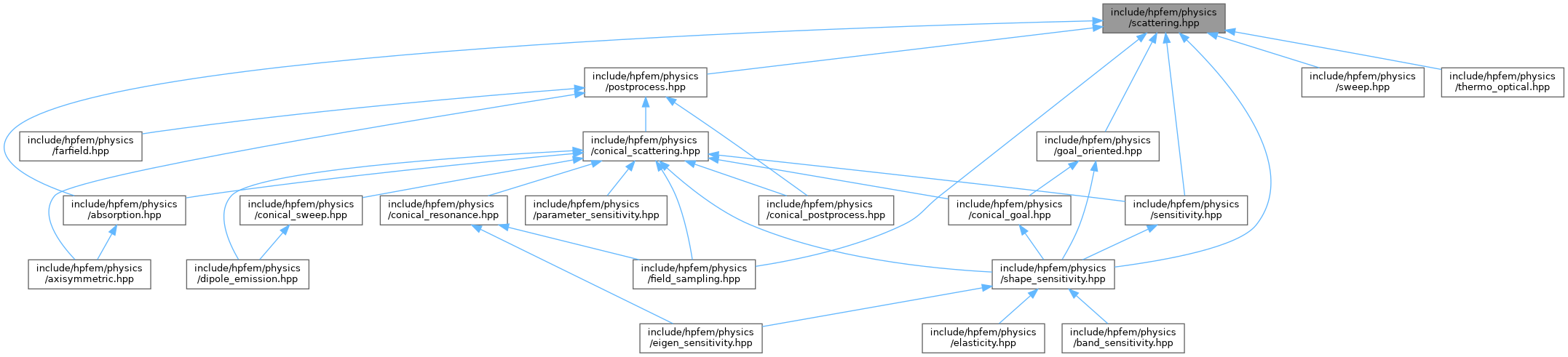
Go to the source code of this file.
Classes | |
| struct | hpfem::physics::ScatteringSetup< Dim > |
| Description of a scattering problem. More... | |
| struct | hpfem::physics::ScatteringSolution< Dim > |
| Coefficients of the unknown field on the DoF map. More... | |
| class | hpfem::physics::Scattering< Dim > |
| Assembles, constrains and solves a scattering problem and evaluates its fields. More... | |
| struct | hpfem::physics::PortChannel |
| One propagating (port, mode) channel of an S-matrix. More... | |
| struct | hpfem::physics::SParameters |
Namespaces | |
| namespace | hpfem |
| namespace | hpfem::physics |
Enumerations | |
| enum class | hpfem::physics::Formulation : std::uint8_t { hpfem::physics::kTotalField , hpfem::physics::kScatteredField } |
Functions | |
| template<int Dim> | |
| SParameters | hpfem::physics::s_parameters (const fespace::NedelecDofMap< Dim > &dofs, ScatteringSetup< Dim > setup) |
| template SParameters | hpfem::physics::s_parameters< 2 > (const fespace::NedelecDofMap< 2 > &, ScatteringSetup< 2 >) |
| template SParameters | hpfem::physics::s_parameters< 3 > (const fespace::NedelecDofMap< 3 > &, ScatteringSetup< 3 >) |
Detailed Description
Time-harmonic scattering at a fixed frequency ω on a Nédélec space: \( \nabla\times(\mu_r^{-1}\nabla\times E) - k_0^2\,\varepsilon_r E = f \), \( k_0 =
\omega/c_0 \), the curl–curl equation of docs/theory/maxwell.md divided by μ0 (SI lengths, so a current source enters as \( f = i\omega\mu_0 J \)). Materials are assigned by cell tag. Either the total field is solved (sources: currents, prescribed incident field on boundaries) or the scattered field \( E^{sc} = E - E^{inc} \) of an analytic incident field, whose volume sources \( k_0^2(\varepsilon_r - \varepsilon_{r,b})E^{inc} \) and \( -(\mu_r^{-1} - \mu_{r,b}^{-1})\nabla\times E^{inc} \) live on the scatterer only. Boundary conditions: PEC, prescribed incident field, PMC (natural), PML as complex coordinate stretching of the material tensors (pml::PmlBox) and Bloch-periodic directions as DoF constraints (assembly::bloch_constraints). Locally refined meshes (mesh::AdaptiveMesh) are supported through assembly::hanging_constraints; Dirichlet data on hanging DoFs is taken from the parent DoFs. See docs/theory/maxwell.md#scattering-problems.
