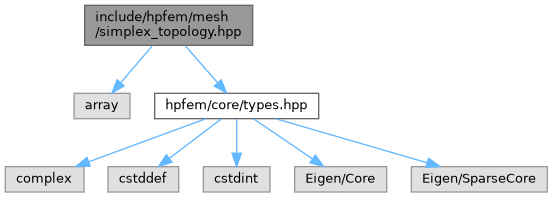
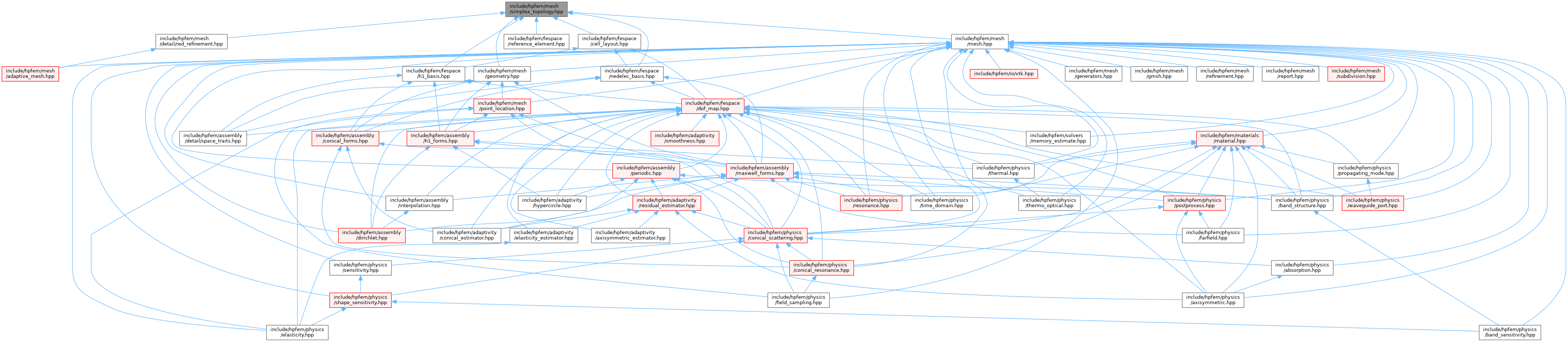
Go to the source code of this file.
Classes | |
| struct | hpfem::mesh::SimplexTopology< 2 > |
| Reference triangle. More... | |
| struct | hpfem::mesh::SimplexTopology< 3 > |
| Reference tetrahedron. More... | |
Namespaces | |
| namespace | hpfem |
| namespace | hpfem::mesh |
Variables | |
| constexpr std::array< std::array< LocalIndex, 3 >, 6 > | hpfem::mesh::kFacePermutations |
Detailed Description
Local (reference-element) numbering of vertices, edges and faces of the simplex: triangle (Dim = 2) and tetrahedron (Dim = 3).
These tables are binding for the whole code base (CLAUDE.md §6, docs/theory/nedelec.md, docs/theory/mesh.md). fespace::ReferenceElement<Dim> re-uses them; nothing may redefine them.
Reference triangle: v0 = (0,0), v1 = (1,0), v2 = (0,1); edges counter-clockwise e0 = (v0,v1), e1 = (v1,v2), e2 = (v2,v0). Reference tetrahedron: v0 = (0,0,0), v1 = (1,0,0), v2 = (0,1,0), v3 = (0,0,1); edges in lexicographic order e0 = (v0,v1), e1 = (v0,v2), e2 = (v0,v3), e3 = (v1,v2), e4 = (v1,v3), e5 = (v2,v3); face i is opposite vertex i, vertices in increasing order.
A facet is the codimension-1 entity: an edge in 2D, a face in 3D. Facet numbering coincides with the edge numbering in 2D and with the face numbering in 3D.
