#include <map>#include <utility>#include <vector>#include "hpfem/assembly/h1_forms.hpp"#include "hpfem/core/types.hpp"#include "hpfem/fespace/dof_map.hpp"#include "hpfem/materials/material.hpp"#include "hpfem/mesh/mesh.hpp"#include "hpfem/solvers/linear_solver.hpp"
Include dependency graph for thermal.hpp:

This graph shows which files directly or indirectly include this file:
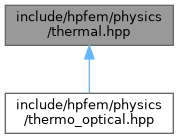
Go to the source code of this file.
Classes | |
| struct | hpfem::physics::ThermalSetup |
| Description of the heat-conduction problem. More... | |
| class | hpfem::physics::Thermal< Dim > |
Namespaces | |
| namespace | hpfem |
| namespace | hpfem::physics |
Detailed Description
Steady heat conduction driven by the absorbed optical power (first multiphysics step): the absorbed power density \( q = \tfrac{\omega\varepsilon_0}{2}\,\mathrm{Im}(\varepsilon_r) |E|^2 \) [W/m³] of a time-harmonic field (convention exp(−iωt), lossy media have Im εr > 0) is interpolated into the H1 space on the same mesh and drives \( -\nabla\cdot(\kappa\nabla T) = q \) with the thermal conductivity κ [W/(m K)] per material tag, fixed temperatures on tagged facets (Dirichlet) and adiabatic walls elsewhere (natural). SI units: T in K. See docs/theory/multiphysics.md.
