#include <functional>#include <map>#include <memory>#include <vector>#include "hpfem/assembly/maxwell_forms.hpp"#include "hpfem/core/types.hpp"#include "hpfem/fespace/dof_map.hpp"#include "hpfem/materials/material.hpp"#include "hpfem/mesh/mesh.hpp"#include "hpfem/solvers/device_stepper.hpp"#include "hpfem/solvers/linear_solver.hpp"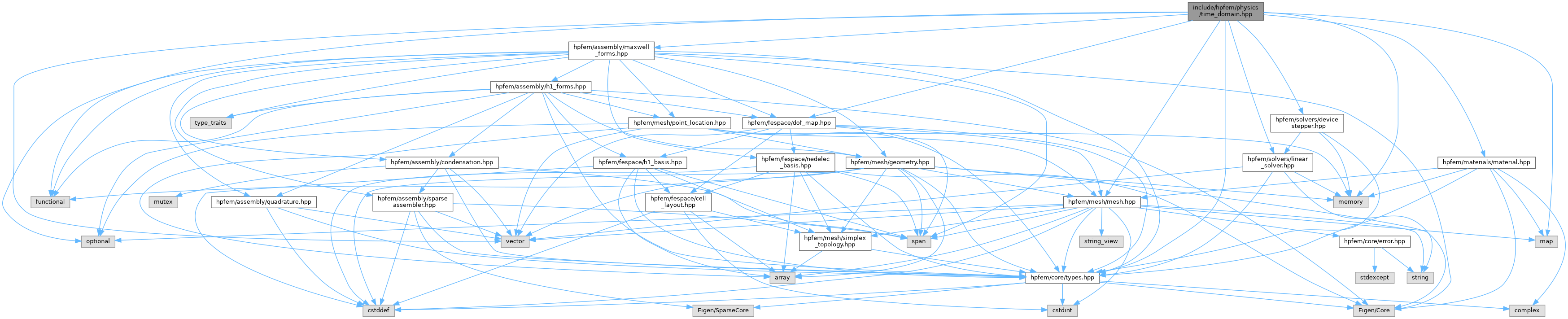
Go to the source code of this file.
Classes | |
| struct | hpfem::physics::TimeSignal |
| Time signal g(t) with its derivative (sources enter through g'). More... | |
| struct | hpfem::physics::TimeDomainSetup< Dim > |
| Description of a transient problem. More... | |
| struct | hpfem::physics::TimeState< Dim > |
| Field, velocity and acceleration coefficients (full DoF vectors, PEC entries zero). More... | |
| class | hpfem::physics::TimeDomain< Dim > |
| Assembles the matrices once, factorises the Newmark operator and advances a state. More... | |
Namespaces | |
| namespace | hpfem |
| namespace | hpfem::physics |
Functions | |
| TimeSignal | hpfem::physics::gaussian_pulse (Real t0, Real width) |
| Gaussian pulse \( g(t) = \exp(-(t - t_0)^2 / (2 w^2)) \). | |
| TimeSignal | hpfem::physics::modulated_gaussian (Real omega, Real t0, Real width) |
| Modulated Gaussian \( g(t) = \sin(\omega (t - t_0))\,\exp(-(t - t_0)^2 / (2 w^2)) \). | |
Detailed Description
Transient Maxwell solver: the second-order wave equation for the electric field \( \varepsilon\,\partial_t^2 E + \sigma\,\partial_t E + \nabla\times(\mu^{-1}\nabla\times E) = -\partial_t J \) (SI units, real materials) discretised with the Nédélec space in space and the implicit Newmark-β scheme in time. With β = 1/4, γ = 1/2 (default) the scheme is the trapezoidal rule: unconditionally stable, second order, and it conserves the discrete energy \( \tfrac12(\dot u^T M \dot u + u^T S u) \) of the undamped problem exactly, so the time step is chosen for accuracy, not stability. Boundary conditions: PEC (tangential trace eliminated) and the first-order Silver–Müller absorbing condition \( n\times\mu^{-1}\nabla\times E = -Z^{-1}\,\partial_t E_t \), a boundary damping term with the wave impedance Z of the adjacent cell. Sources are a spatial current density J(x) times a time signal g(t), entering as \( -J(x)\,g'(t) \). See docs/theory/maxwell.md#time-domain.
