#include <geometry.hpp>
Public Types | |
| using | Nodes = std::array< Point< Dim >, kNumNodes > |
| vertices, then edge nodes | |
| using | ShapeValues = std::array< Real, kNumNodes > |
| using | ShapeGradients = std::array< Point< Dim >, kNumNodes > |
| w.r.t. reference coordinates | |
Public Member Functions | |
| QuadraticGeometry (Nodes nodes) | |
| int | order () const noexcept override |
| Polynomial order of the map: 1 (affine) or 2. | |
| GeometryPoint< Dim > | evaluate (const Point< Dim > &xi) const override |
| \( x(\xi), J(\xi), J^{-T}(\xi), \det J(\xi) \) at a reference point. | |
| Point< Dim > | to_reference (const Point< Dim > &x) const override |
| Real | h () const noexcept override |
| Cell diameter: longest straight edge [m]. | |
| const Nodes & | nodes () const noexcept |
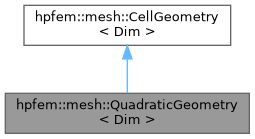
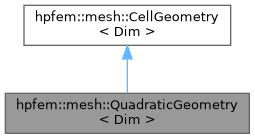
 Public Member Functions inherited from hpfem::mesh::CellGeometry< Dim > | |
| CellGeometry ()=default | |
| CellGeometry (const CellGeometry &)=delete | |
| CellGeometry & | operator= (const CellGeometry &)=delete |
| CellGeometry (CellGeometry &&)=delete | |
| CellGeometry & | operator= (CellGeometry &&)=delete |
| virtual | ~CellGeometry ()=default |
| bool | is_affine () const noexcept |
Static Public Member Functions | |
| static void | shape_functions (const Point< Dim > &xi, ShapeValues &values, ShapeGradients &gradients) |
| Quadratic Lagrange shape functions and their reference gradients at \( \xi \). | |
Static Public Attributes | |
| static constexpr std::size_t | kNumVertices = static_cast<std::size_t>(Dim + 1) |
| static constexpr std::size_t | kNumEdges |
| static constexpr std::size_t | kNumNodes = kNumVertices + kNumEdges |
| 6 (2D), 10 (3D) | |
Detailed Description
class hpfem::mesh::QuadraticGeometry< Dim >
Curved cell with the quadratic Lagrange map \( x(\xi) = \sum_i \lambda_i(2\lambda_i - 1)\, x_i + \sum_{e=(a,b)} 4\lambda_a\lambda_b\, m_e
\) in barycentric coordinates \( \lambda \); \( x_i \) are the vertices in local order and \( m_e \) the edge nodes in local edge order (SimplexTopology<Dim>::kEdgeVertices). With \( m_e \) at the edge midpoints the map is exactly affine.
Member Typedef Documentation
◆ Nodes
| using hpfem::mesh::QuadraticGeometry< Dim >::Nodes = std::array<Point<Dim>, kNumNodes> |
vertices, then edge nodes
◆ ShapeGradients
| using hpfem::mesh::QuadraticGeometry< Dim >::ShapeGradients = std::array<Point<Dim>, kNumNodes> |
w.r.t. reference coordinates
◆ ShapeValues
| using hpfem::mesh::QuadraticGeometry< Dim >::ShapeValues = std::array<Real, kNumNodes> |
Constructor & Destructor Documentation
◆ QuadraticGeometry()
|
explicit |
Member Function Documentation
◆ evaluate()
|
overridevirtual |
\( x(\xi), J(\xi), J^{-T}(\xi), \det J(\xi) \) at a reference point.
Implements hpfem::mesh::CellGeometry< Dim >.
◆ h()
|
inlineoverridevirtualnoexcept |
Cell diameter: longest straight edge [m].
Implements hpfem::mesh::CellGeometry< Dim >.
◆ nodes()
|
inlinenoexcept |
◆ order()
|
inlineoverridevirtualnoexcept |
Polynomial order of the map: 1 (affine) or 2.
Implements hpfem::mesh::CellGeometry< Dim >.
◆ shape_functions()
|
static |
Quadratic Lagrange shape functions and their reference gradients at \( \xi \).
◆ to_reference()
|
overridevirtual |
Reference coordinates of a physical point (Newton iteration for curved cells).
- Exceptions
-
Error if the iteration does not converge (point far outside the cell).
Implements hpfem::mesh::CellGeometry< Dim >.
Member Data Documentation
◆ kNumEdges
|
staticconstexpr |
◆ kNumNodes
|
staticconstexpr |
6 (2D), 10 (3D)
◆ kNumVertices
|
staticconstexpr |
The documentation for this class was generated from the following file:
- include/hpfem/mesh/geometry.hpp
