#include <mutex>#include <span>#include <vector>#include "hpfem/assembly/sparse_assembler.hpp"#include "hpfem/core/types.hpp"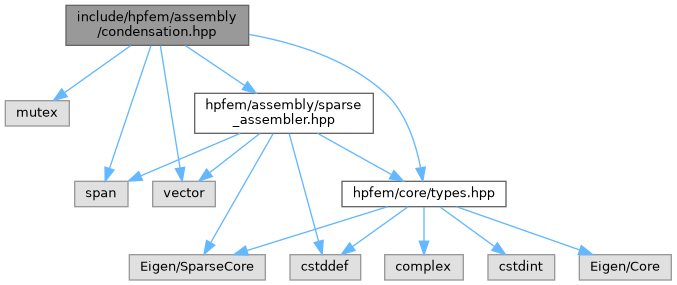
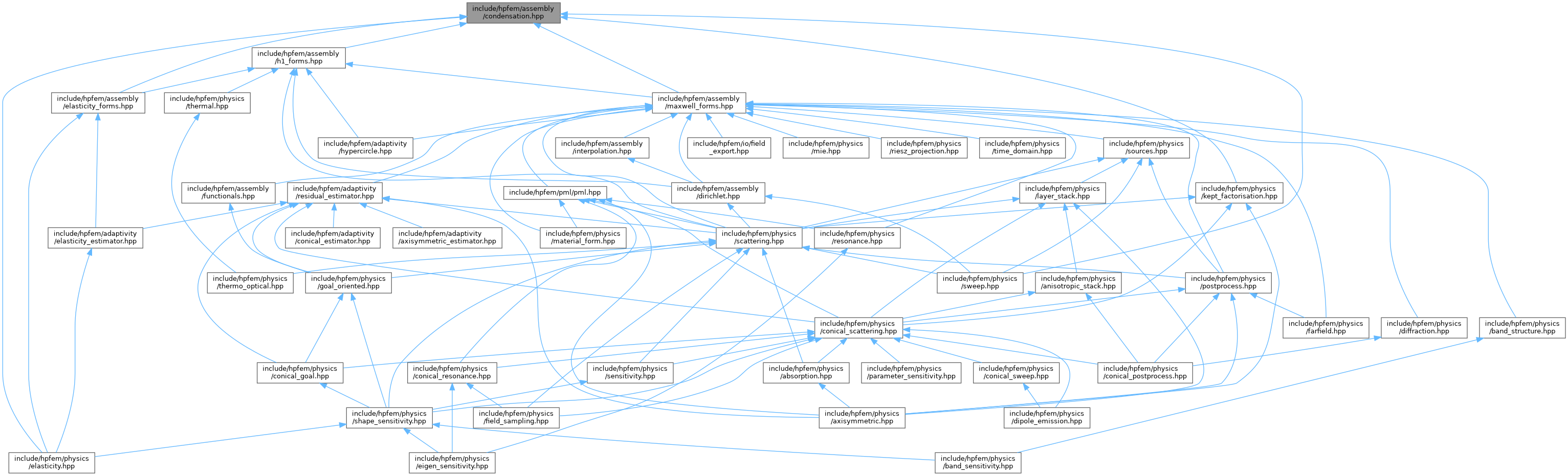
Go to the source code of this file.
Classes | |
| class | hpfem::assembly::StaticCondensation |
Namespaces | |
| namespace | hpfem |
| namespace | hpfem::assembly |
Detailed Description
Static condensation of the interior (cell-bubble) degrees of freedom. The local system of a cell splits into exterior DoFs E (vertices, edges, faces — shared with neighbours) and interior DoFs B (supported in the cell only); eliminating B cell by cell gives the Schur complement
\[ \tilde K_{EE} = K_{EE} - K_{EB} K_{BB}^{-1} K_{BE}, \qquad \tilde f_E = f_E - K_{EB} K_{BB}^{-1} f_B , \]
which is assembled instead of the full local system; afterwards \( u_B = K_{BB}^{-1}(f_B - K_{BE} u_E) \) is recovered. The global numbering is kept: the interior rows of the condensed matrix are identity rows with zero load, so Dirichlet elimination and the hanging / Bloch constraints (which never touch interior DoFs) apply unchanged, and the direct solver factorises a matrix whose coupled part has only the exterior unknowns. See docs/theory/solvers.md#static-condensation.
