#include <axisymmetric.hpp>
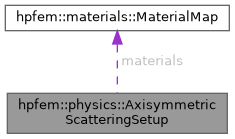
Public Attributes | |
| Real | omega = 0 |
| angular frequency [rad/s] | |
| materials::MaterialMap | materials |
| by cell tag; the background for unlisted tags | |
| std::vector< mesh::Tag > | pec_tags |
| facets with n × E = 0 (scattered field = −incident) | |
| mesh::Tag | axis_tag = mesh::kNoTag |
| facets on the axis r = 0 (required) | |
| int | azimuthal_order = 1 |
| m of the incident component | |
| std::optional< pml::PmlBox< 2 > > | pml |
| std::optional< LayerStack< 3 > > | background |
| AxisymmetricField | incident |
| m-th component of the incident field (scattered-field formulation) ... | |
| AxisymmetricField | current |
| solvers::DirectSolverBackend | solver = solvers::DirectSolverBackend::kAuto |
| int | extra_quadrature_order = 4 |
| added to 2p for the non-polynomial incident field | |
| int | pml_extra_quadrature_order = 6 |
| bool | keep_factorisation = false |
Detailed Description
Description of an axisymmetric scattering problem (scattered-field formulation): the incident field is a solution in the background medium, the source \( k_0^2(\varepsilon_r - \varepsilon_{bg})E^{inc} \) lives in the cells whose material differs from the background, the PML absorbs the scattered field. The background is one material (materials.background()) or a planar layer stack normal to the axis (background, ADR-0014).
Member Data Documentation
◆ axis_tag
| mesh::Tag hpfem::physics::AxisymmetricScatteringSetup::axis_tag = mesh::kNoTag |
facets on the axis r = 0 (required)
◆ azimuthal_order
| int hpfem::physics::AxisymmetricScatteringSetup::azimuthal_order = 1 |
m of the incident component
◆ background
| std::optional<LayerStack<3> > hpfem::physics::AxisymmetricScatteringSetup::background |
Layered background (ADR-0014): planar layers normal to the axis, the z of the stack is the y of the meridian mesh. The incident field is then the stack's plane wave of order m (layered_axisymmetric_wave), the source \( k_0^2(\varepsilon_c -
\varepsilon_{stack}(z_c))E^{inc} \) lives only where the material of a cell deviates from the stack at its centroid (particles and holes alike), and no cell of the PML may deviate (the deviation must be bounded). Interfaces must lie on mesh lines; the materials of the layer cells are given by tag in materials as usual.
◆ current
| AxisymmetricField hpfem::physics::AxisymmetricScatteringSetup::current |
... or the volume source f = iωμ0 J of order m (total-field formulation, e.g. axisymmetric_gaussian_dipole); exactly one of the two.
◆ extra_quadrature_order
| int hpfem::physics::AxisymmetricScatteringSetup::extra_quadrature_order = 4 |
added to 2p for the non-polynomial incident field
◆ incident
| AxisymmetricField hpfem::physics::AxisymmetricScatteringSetup::incident |
m-th component of the incident field (scattered-field formulation) ...
◆ keep_factorisation
| bool hpfem::physics::AxisymmetricScatteringSetup::keep_factorisation = false |
Keep the factorised system in the solution (AxisymmetricScatteredField::factorisation) for further loads on the same operator: other heights of a dipole, other incidences of the same order, and the order −m by AxisymmetricScattering::mirrored (issue #214).
◆ materials
| materials::MaterialMap hpfem::physics::AxisymmetricScatteringSetup::materials |
by cell tag; the background for unlisted tags
◆ omega
| Real hpfem::physics::AxisymmetricScatteringSetup::omega = 0 |
angular frequency [rad/s]
◆ pec_tags
| std::vector<mesh::Tag> hpfem::physics::AxisymmetricScatteringSetup::pec_tags |
facets with n × E = 0 (scattered field = −incident)
◆ pml
| std::optional<pml::PmlBox<2> > hpfem::physics::AxisymmetricScatteringSetup::pml |
absorbing layers (r-max, z-min, z-max)
◆ pml_extra_quadrature_order
| int hpfem::physics::AxisymmetricScatteringSetup::pml_extra_quadrature_order = 6 |
added to 2p in PML cells
◆ solver
| solvers::DirectSolverBackend hpfem::physics::AxisymmetricScatteringSetup::solver = solvers::DirectSolverBackend::kAuto |
The documentation for this struct was generated from the following file:
- include/hpfem/physics/axisymmetric.hpp
